
Mothering Christ
Christ heals our fears by coming to us as a baby.

“Perfect love casts out fear.”
For Christians whose upbringings featured less-than-perfect models of love, it can be hard not to approach God from a place of fear. It’s all too easy, on the other hand, to see God as a father who cannot be trusted, who might at any moment fly into a rage, who is threatened when his children feel safe, happy, or strong – though this perception of God happens at the level of the body, not the mind.
Christians who had this kind of upbringing will likely scrutinise themselves closely to guard against angering their unpredictable God; they will constantly be on the lookout for the “something wrong” they might do to cause the “something bad” that will happen to them as a result. It’s nearly impossible, from this place of fear, to find in God the promised refuge.
Christ said, “Whoever does the will of my Father in heaven is my brother and sister and mother.” And mother. Mary, in the witness of her life and in her apparitions, always makes it clear how much she wants to share her Son with us. “My Jesus and yours,” she says. We are called to mother Christ.
Thinking of Christ as a baby who wants me to mother Him has helped to heal a lot of the fear with which I have grown accustomed to approaching God. Out of unexamined habit, I relate to God as though He were a trickster always ready to catch me out; as though His love for me were conditional and dependent on my efforts – a small, easily withdrawn love, snatched out of sight at the first sign of failure on my part. I know with my mind that this is not the Christian revelation of God, but what use is the mind when “the body keeps the score”?
By coming to me as a baby Christ has helped me understand in my body those truths which my mind has been told. “Though your sins are like scarlet, they shall be as white as snow; though they are red like crimson, they shall be as wool.” “As far as the east is from the west, so far has He removed our sins from us.” “God is love.” A baby doesn’t care one iota what his mother has done in her past; he just wants her. He doesn’t care that she isn’t perfect (although she is, in his eyes); he just wants her love, her attention, her time. He wants all of her. He doesn’t hold anything against her but forgives her totally for everything. He is gazing at her constantly with the gaze of love and is content once she meets his eyes. This is how I have come closer to understanding the incomprehensible magnitude of the love God has for us. This is the perfect love that casts out fear.
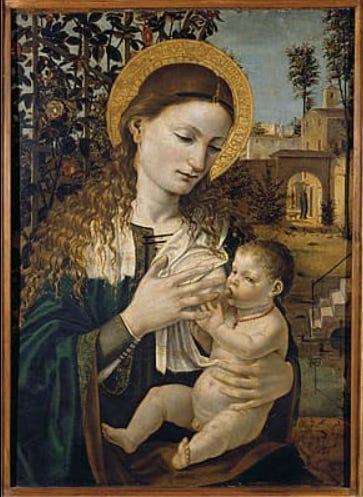
Over the last seven-and-a-half months my first baby has grown inside me. I feel him moving, sometimes so close to the surface and sometimes deep within — reaching out to me from the dark, hidden world of my womb. At times I have found it almost unbearable to know that he loves me unconditionally. How, in other words, can I accept the love of God? My baby comes from God; God is knitting him together in my womb. He was made from love for love and all he knows how to do is love. He is a being of love, totally innocent, and his love is something like that of God: total and unconditional. I must open to it and allow it to transform me, as birth will open and transform me.
Caryll Houselander spoke about the Host in the monstrance as being like a baby, coming to us defencelessly and with total vulnerability. Christ’s love for us is so un-self-protective. He keeps nothing hidden, nothing up his sleeve. He comes knowing He could be discarded, trampled underfoot. He makes himself helpless, dependent on us. When we turn from the Lord and ignore Him, it’s like leaving a baby alone to cry. Maybe that is the wrath of God. Perhaps mothering Christ is a way both to console Him in the Eucharist and to heal our own wounds around fearing God; a way to approach Him, in the Eucharist and in all times and places, like a mother reaching for her child, pressing Him to her breast in theosis.