Spiritual Marthahood
Finding rest after religious anxiety.

It was a January evening and I was washing my hands in the presbytery bathroom. I’d spent the past two hours sitting upstairs with a group of kind, open-hearted Catholic women, praying and talking about our struggles and challenges in the spiritual life, both generally and in particular on our journey with Fiat90, the 90-day programme for Catholic women leading up to Lent. This was the first of our sessions, and we would meet every week for the next three months. The world outside the windows was dark, and we had talked over candlelight and mugs of tea.
While I had found being in the company of these women restorative, the moment I was left to my own devices I had taken the comfort and relief I’d found in their conversation and turned it inwards, twisting it into a weapon I could use against myself. The struggle to which I had confessed during the meeting had been spiritual dryness. I was now berating myself for the fact that none of the other women had talked about spiritual dryness, that their relationships with Jesus were all alive and well, fed with living water. Clearly there was something wrong with me, something missing; some gap I had to fill, a problem to fix.
As I switched off the tap and searched for a towel to dry my hands, I was mentally sifting over what the other women had shared about how they prayed, cataloguing their habits so I could imitate them, drawing up a list of all the things that I must start doing now and stop doing or else, scheduling a new daily routine for myself. I shot off a few prayers to Jesus to help me with this — no, to ask Him to make me do it — my heart tight and constricted, the voice with which I prayed hard and pressing. And then two words dropped into the mental noise like a pebble into a churning lake: “Daughter, rest.”
Those two words cut through the tension in my body, the anxious knot in my stomach, and pulled me up short. I realised that although I was in the presbytery bathroom, I wasn’t really there. I wasn’t even seeing the room in front of me. My mind was pulling me onwards into some imagined future; out of the present, out of my body, out of reality and the life that God had given me. I realised how fast and jerky all of my movements were. My brow was furrowed, my face set in hard lines. Everything about me both physically and mentally was harsh and somehow punitive.
I heard those two words and realised that I needed to calm down a bit, but that was as far as I took it. I didn’t apply the words to the thing I was actually exhausted by: prayer itself.
I had become overwhelmed and burned out by a seemingly constant stream of novenas and devotions and most of all by the obligation, from Fatima, to pray the rosary every day. My mind, already overactive, felt exhausted by the requirement to visualise the mysteries. I wondered if I could simply say the words and let my mind rest, but feared that this was a temptation. I woke up every morning with a guilty knot in my stomach because the rosary was hanging over me like a chore. Something I had once enjoyed was now something I did from a place of fear — fear that I might be punished with Hell if I didn’t.
Those two words couldn’t mean what I secretly wanted them to mean: that maybe, just maybe, God was telling me it was okay to take a break from prayer. God obviously wouldn’t be telling me that, and I was terrified by the fact I was even entertaining the thought. How could I even trust the possibility that God might be okay with me not praying the rosary every day if Mary had said at Fatima that we had to?
I knew the Scriptures, I knew that Jesus told us to come to Him and that He would give us rest; but this obviously didn’t apply to my prayer life. Prayer was not something I could possibly need rest from. If anything, I needed to pray more: prayer was what would bring me closer to Christ, to my rest. If I wanted to stop, if it was making me anxious, that only spoke to my own failure, my own sinful inclinations and susceptibility to diabolic temptation.
Winter passed, the days grew longer, and Fiat90 drew to a close with light in the windows as we spoke and prayed, the world beyond — the sea, the jewelled windows of the church — illuminated. Over those months, my anxiety about Fatima had niggled in the background, occasionally flaring up into full-blown panics of which my husband, with saintly patience, had borne the brunt. I’d become a bit obsessive, unable to leave it alone. I kept trying to square it with the Mary I thought I knew. My husband did his best to help me but I couldn’t understand how an apparition could be both approved by the Church but also not something we were required to believe. Either it was true or it wasn’t, and if it was true then it meant a lot of other things were true as well, such as a massa damnata style theology of Hell. I’d become very fearful, scrupulous in my confessions and legalistic in my attitude to my sins.
In May, the month of Mary, my husband and I went to Glastonbury. We spent 5 days in the birthplace of Christianity in England, staying in a farmhouse nestled right at the foot of the Tor. We lounged around the grounds of the Abbey ruins, dozed off in the orchard in the warmth of the sun. But even though we were on holiday, taking a break from work, enjoying each other’s company in peaceful and idyllic settings, I was still being followed around by the same anxiety that had become the norm for me at home, a constant, background sense of unease.
One evening, I had another spiral about Fatima. The next day, I confessed my confusion to the priest in Glastonbury, and afterwards my husband suggested I take some time to just sit in the Chalice Well gardens. I found a quiet spot, a bench surrounded by roses, and let the beauty of the surroundings and the peace of the place settle over me like a mantle. Those two words I had heard back in January, “Daughter, rest,” drifted into my mind, and were followed by the return of the thought that God might be calling me to rest and that maybe, just possibly, that included taking a break from my prayer routine as it currently was.
I got out my journal and began to write. Could prayer be as simple as opening the heart? I just want to open my heart. It seems like I am being called to rest; to stop using words in my prayers, to stop thinking, to stop imagining, but to just drop into my heart and be still. But can I trust that this is where God is calling me? Can I trust that Mary’s message to me right now is not “pray the rosary every day” but simply Fiat, Fiat, Fiat? What about Fatima? I feel like this is just wish fulfilment; I’m just projecting onto God what I want him to say but of course He isn’t really. Can I just live the life He has given me and let that be prayer? Can I just receive the world as it is and let that be prayer? Can I just stop thinking and be in my heart and spend time with God there? No, I’m treating God like a self-help book…
Quite soon I wasn’t journalling so much as battling, waging civil war between these two instincts: one, that it might be okay to take a break from all my “duties”, and that perhaps this was even what God wanted for me; the other, that any such feeling was absolutely not to be trusted and should instead be feared and resisted. Ostensibly I was trying to make sense of my thoughts; really I was scrutinising them like an inquisitor poring over the writings of a suspected heretic.
I wrote for well over an hour, only looking up when I became aware of raised voices over by the angel seat. A discussion between two women had been getting steadily more heated until it now spilled over into an ugly, vicious argument. In hindsight I can see how this argument, shattering the peace of the gardens, reflected my own tumultuous inner state, belying the apparent restfulness of my body.
What it comes down to is that I couldn’t bring myself to believe that God might be telling me to rest. I felt, simply, that this was too good to be true. That’s what I kept writing, over and over again in different ways: no, this is self-indulgence; you are being tricked, led astray, deceived. It was only when, the following month, my husband confessed to me that he had also been experiencing spiritual burnout that the fear fell away enough for me to trust that rest was what God was calling me to, calling both of us.
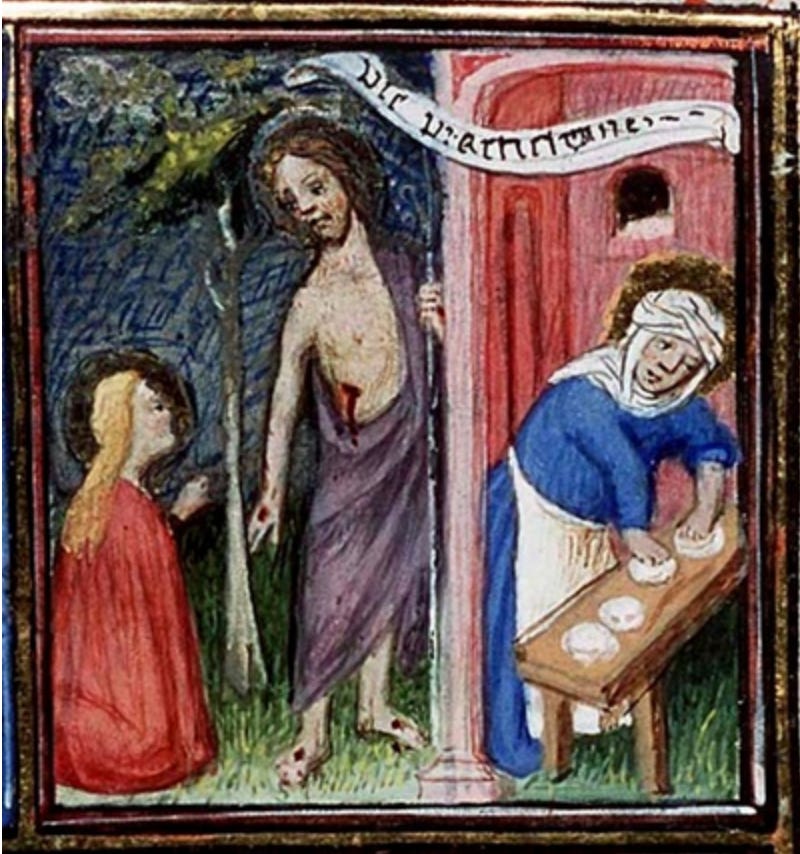
I began looking less to Fatima and more to Scripture to find answers to questions like: what does Christ want of me? What is He asking of me? I started to look at Jesus’s interactions with women in the gospels for a guide, and I thought about the story of Mary and Martha. In the story, Mary is sitting at Jesus’s feet while her sister, Martha, hurries around, trying to do everything at once. When Martha asks Jesus to tell Mary to get up and help her, Jesus says, “Martha, Martha. Mary has chosen the better part, and it shall not be taken away from her.”
I realised that perhaps I had become a spiritual Martha. I had been mentally running around trying to do everything, pray every devotion, visualise every mystery perfectly, exert all my will and effort, when really all the Lord was asking me to do was to sit at His feet and listen to Him. I had become so distracted by my attempts at prayer that I had failed to actually pay attention to God.
I hadn’t listened when He’d spoken to me, but now I want to truly listen, to contemplate those two words and let them sink deeply in: Daughter, rest.